
Talking Past Each Other
On the radioactive waste of toxic friendships.

When I was in secondary school, I knew a kid called Tristan who didn’t like me very much and whose company made me not like myself very much. He was my best friend.
Tristan knew how to make me feel small and stupid the way only a certain kind of guy friend can make you feel stupid and small. He laughed harder than anyone when a kid pointed out how big my ears were, he helpfully listed the ways my clothes weren’t cool, and for a whole school year he stopped being my friend when some popular kids let him join their group.
There was also this time when Tristan and I were maybe ten years old, and we were sneaking around the kitchen at his dad’s place. We weren’t doing anything bad, but we liked to pretend we were, like danger was one impulsive choice away. Being stupid was our favourite kind of fun.
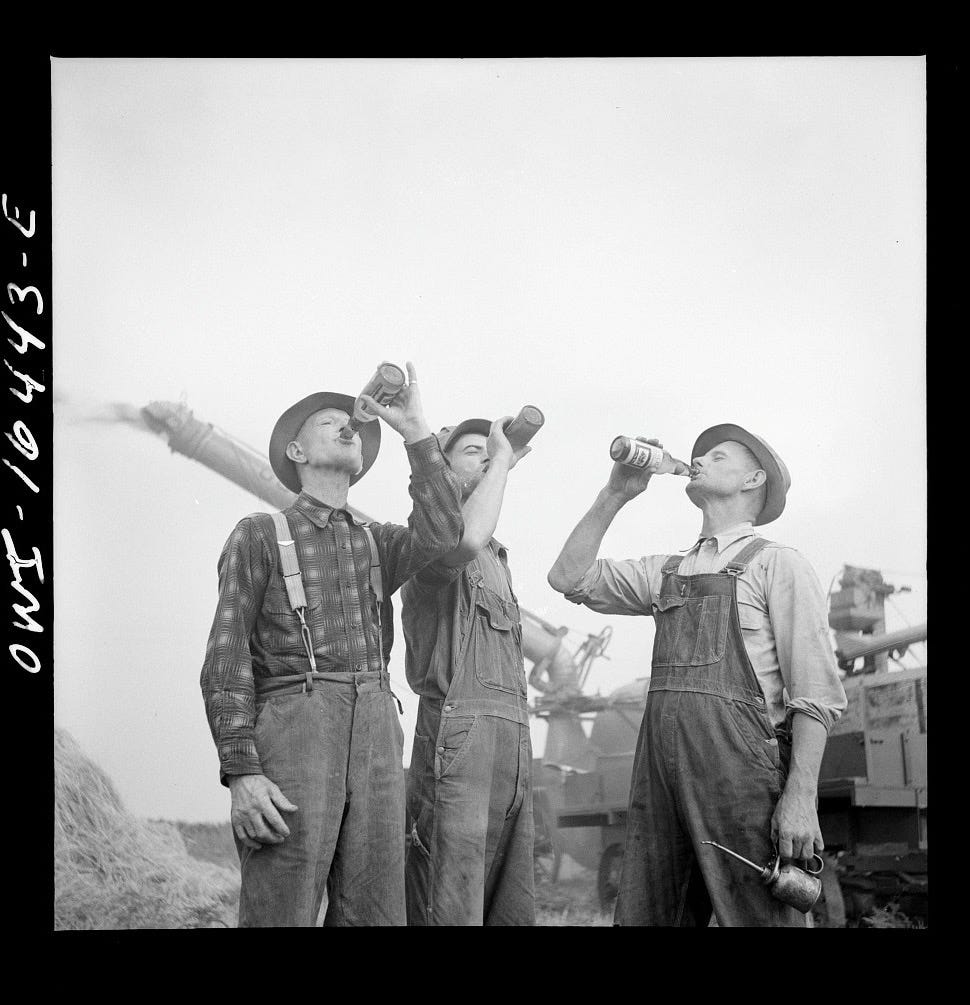
Tristan listened for his dad napping upstairs, then dragged a rattan chair away from a table covered in more ashtrays than one man needed and a crumpled box of cigarettes we weren’t yet daring enough to touch. Standing on the chair, he opened a cupboard and took a brown bottle out of it. He showed me how to use a bottle opener. The smell puffed out of the bottle the way bubbles hiss out of a can of coke. Tristan shoved the drink under my nose and said, “Smell.”
I jerked back immediately (I thought it smelled like bad fruit and a fart) and Tristan pointed at me, laughing, describing how stupid my face looked when I grimaced. I wish I’d been clever enough to ask who looked good when they grimaced.
“Lager,” Tristan said.
“Logger?” I said. “Like a guy who cuts down trees?” (In our working-class town in the nineties, we didn’t say things like, “A guy — or girl — who cuts down trees,” but in my late teens, overtly making those distinctions became an obnoxious part of my identity.)
“No, you idiot,” Tristan said. “Lager with an ‘a’, not an ‘o”.”
This was only a year or two since my family had left Canada, and I was still confused about the way people in England pronounced even familiar words. My first problem was the Glottal-sodding-T, an exceptionally ugly abuse of throat muscles in the disservice of the English language. It makes my brain retch every time I hear the T’s dropped out of a buh-in, a sih-ee, or a keh-ul.1
My other big source of linguistic alienation was the Absent R (“aah”). I couldn’t get my head around how the English say — actually, how they don’t say — the letter ‘r’, which meant I thought Tristan was simply not saying an ‘r’ and that the drink was “larger” with a hard ‘g’.
So I wasn’t English enough or cool enough to know how “lager” was spelled. I went on thinking it was spelled “larger” for a long time, until one day I was in a supermarket with my mum and I saw those brown bottles high up on a shelf, and the price tag below them said 6 pack Lager and I realised my mistake. I thought I finally understood the differences between my accent and these foreign locals around me, but this sent me back to puzzling out how I was supposed to say every new word I learned.
I wasn’t allowed to forget my outsider’s incomprehension of the word “lager”. For a while after that, Tristan turned words like “dog” and “log” into “darg” and “larg” with an emphasis on the r that made his mockery sound less like an awkward Canadian and more like a pirate. And one night a couple of years later, we were sneaking around again — this time in the kitchen of the café his mum ran and lived above — and Tristan handed me another brown bottle and said, “Go on, dare you.”
I thought this might be the moment I regained some cool, proving myself as a young man on any rung above total novice regarding alcohol. Tristan pulled a plug from the top of the bottle, and the fumes that came wafting out singed my nose hairs.
“S’good,” Tristan said. “Not like lager.”
“This isn’t lager?”
“Jack Daniels. Much better.”
Having never had so much as the thimble of wine that went around at church for communion (kids were given grape juice), I had no idea about the etiquette of drinking alcohol or that it would burn my throat. I thought I was supposed to drink it like juice. So I chugged it down the way I chugged down juice.
I immediately belched it all back up.
I leaned over a sink and gagged, and spat, and tears came out of my eyes as freely as snot and bourbon came out of my nose, and Tristan was laughing the whole time. He kept his distance, laughing, and said, “You’re meant to sip it!” I started laughing too, to be in on the joke and not the butt of it. The self-deprecating streak in my sense of humour was born with my head over a sink, laughing at myself to drown out the sound of my sort-of-friend laughing at me.
I think Tristan must have been doing something like that, laughing at me to drown out the voice inside that made fun of him. Whatever cruel words were in his internal monologue came out of his mouth like bullets and when I got in the way I got hit. Tristan exploited whatever was broken in my self-esteem, because of whatever was broken about his. But all teenage boys are dicks in their own way, and I could be cruel too, so bygones and whatever.
Tristan and I remained sort-of-friends until we left school at sixteen, and we never spoke to each other again. That was also when I started making real friends at college, and eventually I thought those years with Tristan were purged from my mind and my heart. But those toxic friendships have a radioactive waste that decays slowly over a lifetime.
Decades later, I moved to Mexico and fumbled constantly with trying to translate my personality from English to the local lingo. The hardest part was conveying the particular way irony manifested back home. One night while having cervezas outside a café, I complimented one of our local friends, a handsome young lawyer so well put-together you assumed he must also be dim-witted or boring, but no, God really had given with both hands in his case. “You’re good-looking and intelligent,” I said. “I hate you for that.”
His smile collapsed like a building falling in on itself. For some reason, I thought doubling down might be a good way to back out of this faux pas. “I love you, you idiot.”
My failure to fix the situation was a total success. My friend was dead quiet for a few minutes while the others faked a happy conversation about nothing. Finally, I turned back to him and asked what was up.
“You said I am an idiot.” His voice was quiet, his kind eyes had never looked so sad, and it annoyed me how bad I felt.
“That’s how guys where I’m from show their friendship! I call my best friend at home a dickhead all the time. We don’t mean it. We mean that we like each other, and we show it by saying things we, you know, don’t mean.”
He looked at me like I made no sense, and I realised I made no sense to myself. So I told him sorry and squeezed his arm, and the night went on with each of us doing our best in second languages to say what we really meant.
That’s a button, a city, and a kettle. There is one exception to my revulsion: I think the glottal stop becomes mystically beautiful when someone asks, “Woss a mah-ah?” which means, “What’s the matter?” In the casual flow of speech, it sounds like an incantation. Wossamahah!
We learn how to be in friendship from our childhood friends. Your ending was really important because it’s only through that awkward moment where someone unintentionally hurts someone and they realize they have that people even hear what toxic remnants they still have circulating.
Great writing. I read somewhere that resentment settles in the stomach like toxic waste with nowhere to go and some past "friendships" have certainly found a home there in me.