

Imaginary Friends & Real Tears
Notes From the Desk.

Hi folks,
After my Watterson essay was published in The Republic of Letters, two things happened. First, I was gloriously inundated with stories from readers about how they came to meet Calvin and Hobbes, and what the duo meant to them. Second, I finally reached 1,000 subscribers.
Thank you so much for being a part of all that. I’ve been working away at Volumes for almost ten years now, and much of that time has felt very lonely, so both of those above facts go a long way toward creating a feeling of community. It’s nice to be writing for readers, and even better to be writing for my readers, who have shown themselves to be a great group of people.
In gratitude, I wanted to tell you my own story of how I met Calvin and Hobbes, as a kind of supplementary piece to the Watterson essay.
Again, thank you for reading.
Matthew
In the first summer of the new millennium, my aunt took me to the Greater Victoria Public Library on Vancouver Island. I was thirteen, visiting family in Canada, and now I was home twice over: back in the old country, which I associated with mountains and the ocean and a happy home, and in the library. Wearing the Space Jam shorts and bright orange tee-shirt that was my outfit at that unfashionable age, I looked through the stacks and found a cartoon strip called Calvin and Hobbes. I sat cross-legged on the floor to read it, and pretty soon, I was one of Calvin’s millions of fans and another lonely kid desperate for his own Hobbes.
There were three pages, late in the book, where I worked out how much of a fan I’d become. It was a tale of Calvin losing Hobbes. He bursts into his house, screaming loud enough to give his speech bubble jagged edges, “MOM! MOM! A BIG DOG KNOCKED ME DOWN AND HE STOLE HOBBES!” Over six strips that were first published over a whole week, we see Calvin sob for his lost friend, bargain with the universe, and make a “lost tiger” poster to put up around the neighbourhood. Eventually, we learn (before Calvin does) that his nemesis, Susie Derkins, has found Hobbes.
After just a few panels, my bottom lip began to tremble and something in my chest tightened like when I was in trouble for not doing my homework. I couldn’t stand the thought of Hobbes being lost, of Calvin losing Hobbes. The suspense must have been worse if you were reading these strips one a day, back when they were first printed in the papers. “This early story lasted only a week,” Watterson writes in the Calvin and Hobbes: Tenth Anniversary Book, “but people wrote worried letters about Hobbes before the story was resolved. It was a good sign that people were connecting with the characters.”
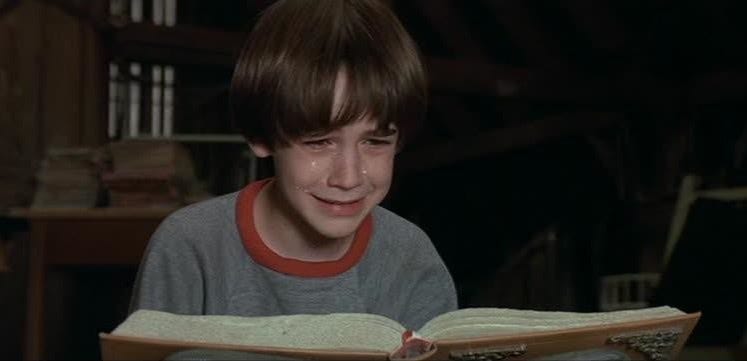
This happens with a lot of my reading. When a beloved character dies in a novel, I feel like I’m truly bereaved, even as I recognise that nothing has “happened” outside of a particular sequence of letters printed on paper. Nicholson Baker tells a story in The Way the World Works about his mother reading The Hobbit to him when he was a kid, and how he was devastated by the death of Thorin Oakenshield. “I wept hard,” he says, “until I fell asleep.”
My sister recently re-read a favourite novel and her husband came into the room after she’d read a painful scene. “What’s wrong?” he asked, concerned at finding her hiccupping back tears. “Henry died!” she answered. It took a few minutes for him to work out that Henry was a character in her book, and when he did, my sister was sure his sympathy noticeably decreased. She insisted he needed to comfort her as if Henry had been a flesh and blood friend. My sister was also heavily pregnant at the time, so she doesn’t rule out her mess of hormones as having something to do with the size of her response — but she knows, as I do, as all readers do, that the feeling of loss is real even if the object of loss isn’t.
In this instance with Calvin losing Hobbes, it was doubly weird to get choked up over a fictional character because even within the world of the story, Hobbes is only an imaginary friend. He’s made-up twice over. Or is he? Is Hobbes a stuffed toy that becomes a real tiger when only Calvin is looking, or is he only ever a stuffed toy that Calvin believes (wrongly) is real? The question won’t go away. People have been arguing about it for the last forty years, and as long as people keep reading Calvin and Hobbes, they’ll keep arguing about the ontology of this cartoon cat.
I think this argument is a good way to miss the net, swing and a miss, pick your favourite sports metaphor. “Factual or fictional” is missing the point. He’s real to Calvin in the way Henry is real to my sister, or Thorin is to Nicholson Baker, or Gatsby is to me. We can know one thing and feel another, both at the same time. Art kind of depends on it.
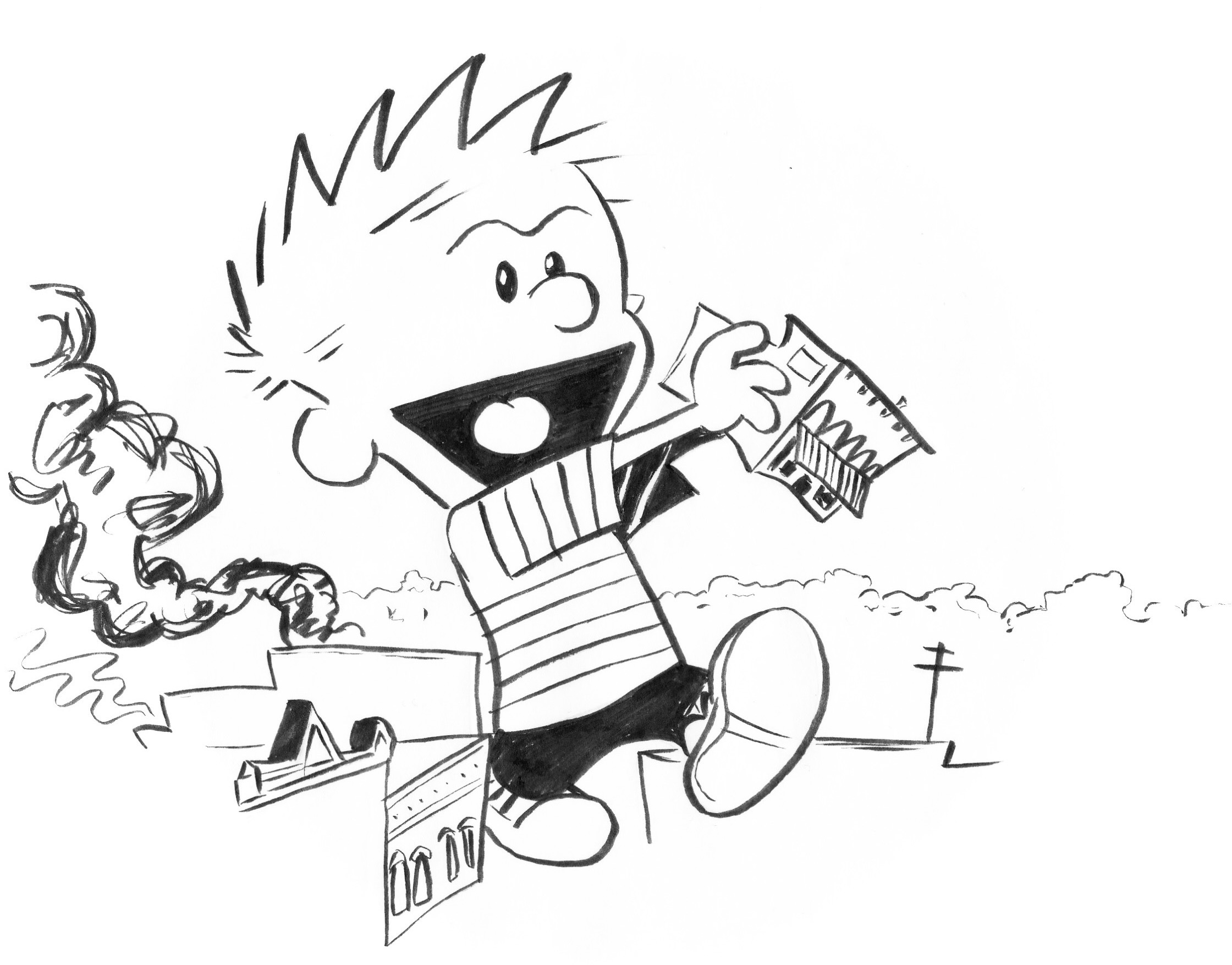
Anyway, I filled the rest of the summer vacation with reading and re-reading that Calvin and Hobbes anthology. I spent long stretches of slow afternoons copying out Watterson’s drawings, and while it was satisfying to get the proportions of Calvin right and to nail the kinetic lines that constitute Hobbes, what filled me with wonder and awe in these panels were the large ice cubes and tapered straw floating in a glass, or the sock escaping from a dresser drawer left pulled out, or the barest lines, more not-there than actually there, that suggest a whole tree. Sometimes Watterson’s work is like poetry, made out of white space and the subtraction of everything extraneous.
Eventually, I learned that the strips collected in this book had first run in daily newspapers, and it became a daydream of mine to read about six-year-old Calvin and his tiger every morning in the newspaper my dad read. I imagined mimicking the way my old man would cross one leg over the other and spread the newspaper across his knees and every few minutes scoff, or smirk, or tut at something he’d read, little noises that declared You’ve got to read this! I can’t think of a better image to sum up what it was to be a thirteen-year-old boy: wanting to emulate my father but with my own twist on the performance, grinning and laughing at the funny pages as I read about Calvin’s adventure with Hobbes that day. Turned out I was too late — Bill Watterson had stopped drawing the comic five years earlier.
Five years earlier was also when my life did a cartwheel and landed on its head. My folks had announced to me and my three siblings that our life in Canada was over, we were leaving for a country on the other side of the world, say goodbye to Grandma and Grandpa and your friends and everything that makes sense to an eight-year-old. I was left stranded in a disorienting isolation that Calvin and Hobbes did a great job of soothing. The strip seemed to be showing me myself, transformed just enough to escape the harder parts of life and similar enough to reassure me that I wasn’t the only one. There’s that C. S. Lewis line about friendship beginning with deep recognition, with a moment of thinking, What, you too? I thought it was just me. My favourite books, Calvin and Hobbes among them, do the same thing.
I learned a little more about the history of Calvin and Hobbes and I did the math: Watterson had started drawing it the year before I was born; he’d been drawing it for ten years when I was almost ten years old; he stopped drawing it the year my life also dramatically changed. Sure, I had to fudge the numbers a little, squint so I didn’t see the places where my life and Watterson’s work didn’t overlap, but that apparent resonance (yeah, I know, barely a coincidence) comforted me. It was a makeshift numerology whose value wasn’t found in empirical facts, but in bringing the illusion of order to chaos.
In reality, nothing connects Watterson’s record-shattering career to my piddling and parochial life, but I’m not so sure that the reality matters. Or it matters, but not as much, not to me, as the connections I notice and create and that contribute to the texture of my life story. What matters is that Calvin and Hobbes became, in the secret cosmos of my imagination, two of my best friends. Like the question of whether Hobbes is a stuffed toy that comes to life or is only an imaginary friend, it’s boring to take these things too literally. The story is truer than facts.
My first meeting with Calvin? Family Guy! Meg has the mumps, and Stewie texts Calvin a picture of her looking hideous, which Calvin laughs at 😂
I don’t think Calvin and Hobbes was widely read in the UK, so I’m pleased to have met him properly now through you, brother.
And you’re spot on about the relationships we develop with characters. Art, at its best, gives us people who aren’t “real,” but are certainly more than imaginary.
Did you read a lot of other cartoons?
thanks for writing this! i did in fact come to your writing thru your excellent calvin and hobbes piece in the republic of letters, but i'm staying because of sentences like this: "I spent long stretches of slow afternoons copying out Watterson’s drawings, and while it was satisfying to get the proportions of Calvin right and to nail the kinetic lines that constitute Hobbes, what filled me with wonder and awe in these panels were the large ice cubes and tapered straw floating in a glass, or the sock escaping from a dresser drawer left pulled out, or the barest lines, more not-there than actually there, that suggest a whole tree." love your writing