

Sitting With Uncertainty
On the wisdom of not having answers too soon.

1.
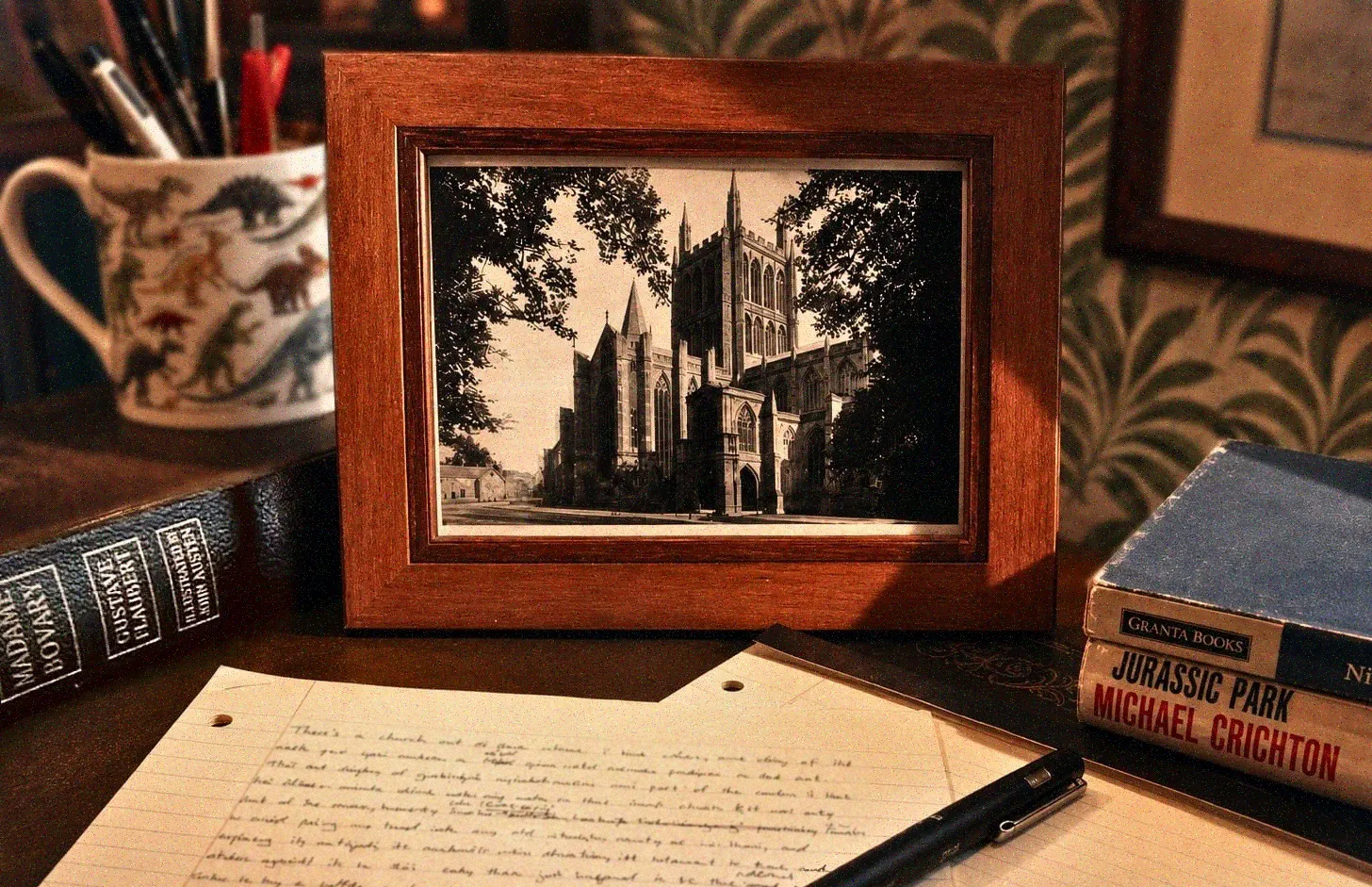
There’s a church not far from my home where, any day of the week, you can see an 860-year-old woman perform a sex act. When my wife, Lauren, tells me about this, I think, Why not? It’s a bright Saturday morning, so we pack up coffee and croissants and head into the country.
We drive down a lane that snakes from side to side in a circuitous way that makes me think of the word “wend”, which comes from German but I’ve attached to England, to these winding country lanes separated from fields on either side by tall, tangled hedgerows and that always lead to a small parish church. The inevitable church here is like so many I’ve seen over so many years. Somehow, the sameness increases their singularity, as if being one small cog in Christendom makes each church work harder to show you something unique.
These singularities are what we’re looking for (including the dirty old woman) as we approach the church. We stop at a wobbly noticeboard beside a wrought-iron gate. The notices pinned to the board have been sun-bleached, leaving only a few stray pieces of information like bits of a meal left in your teeth. Some of it is pedestrian (services on Sunday, you don’t say), some of it esoteric (the church is dedicated to two saints I’ve never heard of), but I’m genuinely impressed when I read that this church was built in 1143.
I try to get my head around the vastness contained in that date. I do the maths quick and rough (the only way I know how to treat numbers): this outpost of a faith that began in the Middle East is, on the timeline, almost as close to Christ as it is to us today. For a second, as I stand in the shade of an ancient yew tree beside an even older church, history contracts and expands. The fact of all this having simply lasted strikes me as incredible.
Lauren and I approach the church slowly, trying not to rush the experience. There are unknown names and distant dates carved into granite headstones, like:
Albert Elwyn
1778 ~ 1841
These names and numbers signify an individual who lived and died here and nowhere else, which I start to appreciate as a small thing and a big thing all at once.
When we reach the church, the first thing we notice is the heavy oak door, carved with dragons eating their own tails, the Green Man (a familiar folk figure in the area), and other things both the academic and the super-churchy lingo might describe as “pagan”. There’s a solid lump of metal you have to twist with both hands to lift a lever that lets you inside. The weight and grandeur of the door don’t impose as you might expect between us and the church. It’s not a barrier; it’s a reassurance that this place knows what it’s doing. Here’s a sturdy ship and if you come aboard you’ll get through life’s storms.
We step into the church and, despite my very modern sense of irony, I try to be awed by the physical space. Lauren recites bits of trivia written on various plaques, and I wonder if here is where I’ll finally have a damascene moment. I sit on a rickety wooden pew and whisper my usual three-word prayer. If anything’s listening, it’ll know what the prayer means. If nothing’s listening, the prayer still means something to me.
Back outside, Lauren spots a face carved in stone beneath the roof, one in a sequence of figures going all the way round the church. Following them leads us to one that, though carved out of the same red sandstone, is distinctly not like the others: a head with bulging eyes, a twist of thick arms and legs that take a moment to make intelligible, and between the legs, hands stretch open her massive genitalia like it’s going to swallow lusty souls who stare for too long. It’s hard to look away.
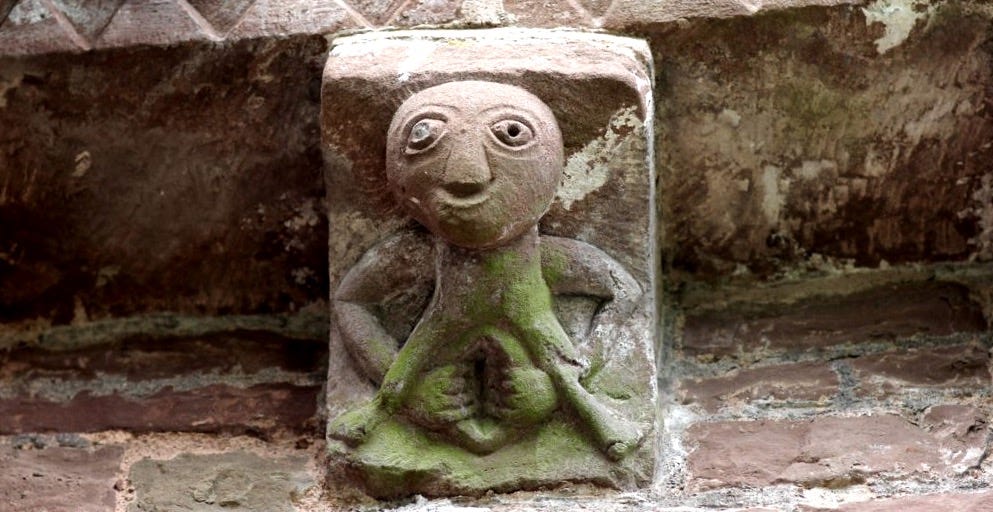
Lauren and I spitball theories to explain the lascivious woman. The morning has long since warmed up, and the lazy sunshine encourages daydreaming.
“Maybe,” I say, “it was a rebellious stonemason who wanted to stick it to the man, and by the time the church leaders saw what he’d carved on their church, it was too late, already there. Nah, that’s stupid, they’d just smash it up. What do you think?”
Lauren’s eyes are following the flight of a couple of sparrows darting around, which makes her look like a soap actor trying to solve an equation in her head. “Yeah, could be…” She seems distracted, but I know the second I bring her attention back to the conversation, she’ll have a fully-formed idea. I nudge her arm, she blinks, she comes back to me. “Cultural differences? Maybe, back then, genitals weren’t so taboo. Or in some contexts nudity moved from profane to sacred?”
“That might be it,” I say. “Did you know the King James Version has the word ‘piss’ in it? I guess back then it was just a word like any other.”
“Is that true?” Lauren looks at me with warranted scepticism — I find it unforgivably funny to wind her up, testing how far her credulity will stretch. I happen not to be fibbing this time.
“I’m pretty sure it’s true. I’ll look it up when we get home.”
Right now in this churchyard, I don’t care if it’s true or not. The truth matters, sure, but it can matter later. For now — strolling in the sunshine, chatting, using the dreamy part of my mind that failed exams but got me through each school day — for now it’s enough that the idea holds together and tells a story. What is can come later; now is the time for what if…?
2.
We circle the church back to where we’d started from and find a quiet spot with a bench. As we eat our croissants and drink coffee, an elderly couple approach us from a different part of the churchyard. I nod and say, “G’morning.”
“Morning!” bellows the man. He is moustached; the passive tense works here because there’s something additional about the fur on his upper lip, as if you can see how his face is meant to work without it but somebody slapped on the moustache like a Mr Potato Head. There’s a shirt-collar poking out of the neck of his wool sweater (despite the heatwave!), and his chinos are folded over the tops of his walking boots, the outfit’s only concession to being outdoors.
His wife, on the other hand, wears an outfit made for wear-and-tear: a muddied fleece rolled up to her elbows; a sweatband lifting her still mostly brown hair out of her pleasantly weathered face; a battered water bottle on her hip that’s all practicality and nothing like those monstrous Stanley Cup fashion statements. I’d guess that while her husband dozes in an armchair with the latest Simon Jenkins book on his lap, she’s walking a 10k on a treadmill in front of the ironing board. Everything about her says, Let’s fucking go.
“We’ve come from Cornwall to see this,” the man says, waving vaguely at the church, the nearby farmhouse, and the hillock over our shoulder where a castle once stood. “Twelfth century. Wonderful example of Norman architecture. You ought to have a look once you’ve had your breakfast. Some lovely carvings — and, of course, the rather dirty one.”
I know what’s coming, and I hope he’ll go away. He doesn’t go away, and I’m right about what’s coming.
“It’s called a sheela na gig,” he tells us. “One of only forty-five in the country, though the Irish have tons of them all over. Came from France originally, the sheela na gigs, brought over by the Normans in their conquest. Meant to be a warning against sin, y’know, against lust and all that… Carved so the illiterate peasants could understand, y’see. I read a very well-argued book by an academic. Well, not a book, an academic article. In the Telegraph.”
The man goes on talking, and Lauren hums noises of polite interest. She’s always been more sociable than me. She can entertain small talk or take the brunt of an imposed lecture on an otherwise quiet morning with total equanimity. I, however, am annoyed. We’d barely got our trousers off with our guesswork about the lewd lady. We’d speculated towards stories we might’ve developed over the rest of the morning, collaborating on their telling, allowing our imaginations to perform their magic. That feels shut down now by knowing the answer.
The same thing happens with friends whose phones are fused to their hands. A question comes up in conversation, the phone is consulted first thing, question solved, move on. With friends who know how to leave their phones alone, conversation surfaces an uncertainty and you’re off arguing about who’s got it right, or comparing ideas about how to get a thing done, or playing that co-op game of Was it the actor from the gay alien movie? Or was it the film no one liked?Life’s more rich and has more depth when we don’t mind sitting with uncertainty.
Obviously, I’m glad we know stuff. But as much as I appreciate the knowing, I love indulging the pleasure of not knowing yet. Maybe call it “unknowing”. It’s not exactly the same thing as ignorance, although ignorance is a necessary ingredient, and you don’t have to refuse to ever know. It’s the joyful state of coming-to-know, an exploration where imagination and facts work together to open up the map by revealing things that could be.
I’m still trying to ignore the bloviation of the man standing over us, so I think about the book I’ll read when I get home. That’s when I realise this “unknowing” business connects to reading a new book and inhaling the first hundred pages without looking up. In that stage, I’m on my way to knowing who these characters are and what’s going to happen to them, but I don’t know yet.
The opposite sometimes happens fifty or so pages from the end of a novel, when I catch myself skimming, noting how many pages are left, shifting irritably in my otherwise comfy reading chair. This doesn’t happen all that often, and it mostly happens with pulpy books, the kind concerned with plot over theme or character.
I’m sure I’ve read something about this phenomenon, but I can’t remember who wrote it or how they phrased it, so I piece it together myself. I think it has something to do with being engrossed in the beginning of a story when everything’s up for grabs, when you have nothing but questions and curiosity about these strangers and their problems. The mental squirming comes in when the final act moves from exploration to explanation. There’s no more mystery and wondering, only understanding how the thing works.
Then again, take a book like Freedom by Jonathan Franzen, a wonderfully indulgent 597-page novel that never runs out of steam or has me itching for “The End”. Franzen never stops exploring his characters and their inner-worlds even right up to the final paragraph. You’re always learning more and being invited to wonder about each new thing you learn, so instead of feeling like the author is shutting the world down, you feel the novel’s expansiveness.
There’s a video-essay by Evan Puschak where he says that the best movies convince you that the world they’re showing in any given scene continues beyond the edges of the frame. You forget the set and the cameras and the director behind them; you helplessly envision the room next to the one the hero’s sitting in, the other diners you can hear who are just out of shot, the in-between moments of travel and going to sleep that we don’t ever see.
This is the same quality in the best endings of great novels: the feeling that this world and its characters and their stories all carry on between the lines, outside the sentences, and beyond the last word in the final chapter. A good ending invites you to keep going.
3.
I’m going to exercise my authorial right to play with the timeline here, because despite the present tense of this story, I’m of course writing it in the future. So let’s hop forward a couple of days to when I decide to re-read Nicholson Baker’s U and I, and there on page one is the quote I’d been groping for, the one about getting restless towards the end of a book.
Baker writes about how a writer builds momentum while working on a novel, which makes completing the book possible but also “imparts a disappointingly thin and rushed feeling to their second halves or final thirds”. And then the bit I was after:
“[The] writer’s growing certainty that he is finally a pro, finally getting the hang of it, coincides exactly with that unpleasant fidgety sensation on the reader’s part that he is locked into a set of characters and surroundings he knows a bit too well by now to enjoy.”
I’m glad to have found the line, to confirm its existence, to feel seen by this other reader-writer. But I’m also glad not to have had the book to hand that morning on the bench by the church, because I’d have read it and thought, Yep, that’s what I mean, and I’d never have developed my own thinking on the matter, the way I did sitting there in my unknowing.
Now, back to the past in the present tense.
4.
The old guy’s lecture on Norman churches finally runs out of steam, so I say, “Well…” which is how English people take their cue to say goodbye and go separate ways. Instead, the wife offers her only contribution so far. “Where’ve the two of you come from?”
“We’re local,” Lauren says. She points to the horizon line just over the woman’s shoulder. “We live in the city, but this is our first time visiting the church.”
The man’s expression is something between horror and incredulity. “You’ll be telling me you haven’t even seen the cathedral I suppose?”
“No,” I say, “or yeah, we’ve seen it. We love it there.”
“Well,” he says, looking away from us, “that’s something.”
Irritation sinks deep into my bones before I remember that I was recently on the other side of an interaction like this. I may not believe in karma, but karma, apparently, believes in me.
See, there’s this massive book festival in my neck of the global woods called Hay Festival. If you live in the UK and have anything bookish about you, then it’s not a matter of whether you’ve heard of it — you have — it’s only a question of how familiar you are with it. If you see yourself as any kind of literary, you’ve been there at least once. If you live within an hour’s drive, you go there most years. If any of the above holds true AND you’re the manager of a bookshop, well — it’s kind of obvious. Or so I thought.
A few weeks before this year’s Hay Festival, I was catching up with the manager of one of my local bookshops. He’s an inspiringly upbeat guy who’s always so keen to see you that, statistically speaking, he must be faking it some of the time, on an off day or right before lunch, but you’d never know it. And he always takes my book recommendations, which is dangerously flattering to a guy who spends most of his time writing about books and half of that time feeling like he’s screaming into a void.
Anyway, I asked the obvious question: which writers was he planning to see at the festival? He told me he didn’t know if he’d make it this year. Then he said, still full of cheer but a note of caution creeping in, “I’ve actually never been to Hay Festival.”
“Wait, really? Holy hell! You’d love it!”
I was excited that he might get to have a first-time experience of something I was sure he’d enjoy. But he made those inconclusive sounds of self-criticism people make to say, I know, what’s wrong with me, I’m awful, I’ve fallen short. The kind of self-flagellation you do to leave no room for others to scourge you.
I tried to walk it back by saying that I get it, some years I don’t bother to go, it’s only a festival, it’s not like he skips his kids’ birthdays. But I knew this hole would only get deeper, so I put down the shovel. I thought about my reaction later, wondering how I might’ve responded in a way I’d appreciate if I were on the other side of the reaction. Actually, I’d been on the receiving end of that reaction many times, because of books I hadn’t read.
You haven’t read the major novels of Dickens?
Nope.
Hold up, you haven’t read Middlemarch?!
Not yet.
You haven’t read THIS? Or THAT?
No, I haven’t read this or that, or any number of books people insist I “should” have read. The number of books I haven’t read will always be greater than the number of books I have read, no matter how many books I read. For every Moby Dick I plough through, there’s still a Jane Eyre and a Silas Marner and a Madame Bovary I haven’t yet touched.
At least I’m in good company: in a piece on his substack about Flaubert, Rumaan Alam tell us that he’s only just read Madame Bovary for the first time. “Yes,” he writes, and I can see the shrug, “I’m almost fifty and never read this book, which I now understand firsthand is one of the greatest novels ever written. Deal with it.”
There’s a story that when Gore Vidal asked David Herbert Donald if he’d read all the books in his impressive home library, Donald said, “No, but I know what’s in them.” Sometimes that’s the problem. I didn’t watch Jaws until I was thirty (deal with it), because I figured I knew what was in it: duh-dum, duh-dum, the shark eats people, they need a bigger boat, “Smile, you sonofabitch!” and they kill the shark at the end. No need to actually watch it.
Then I actually watched it, and I realised I’d been missing out for three decades. Knowledge can’t substitute for experience, and no film was ever watched and no book ever read through cultural osmosis. I try these days to remember that any time I think, I don’t need to actually read Anna Karenina, I already get it. No, I really don’t.
Sometimes the problem comes from the other direction, and I put off reading a book for the same reason I didn’t want to know right away why that figure was carved into the church. There are books sitting on my shelves that I don’t know anything about, beyond their blurb, and as long as they remain unread, they’re full of pure potential. Until I open it, read it, finish and close it, that book can keep me guessing and wondering. It also can’t let me down.
It can be more appealing to keep guessing than to know for sure and be deflated. Of course, mostly what you find is worth more than all your guesses. But once you know, you know. You get to read a book for the first time only once, and sometimes you don’t want to rush it.
5.
While I was away again with the fairies (what my dad calls being lost in thought), the old guy has begun a new rhapsody about church architecture. Lauren is smiling and playing along. Apparently a gargoyle is technically a gargoyle only if it has a spout for rainwater. If it has no practical purpose, it’s a “hunky punk”. Fine, I concede, that is kind of interesting.
Eventually, the couple leave us to our breakfast and hike off, leaving the churchyard through a farmer’s gate. I roll my eyes, and Lauren says, “What?” I eyeball the backs of the departing couple. She frowns. “Them? They’re harmless.”
“I wouldn’t mind if they’d stopped to chat, but I didn’t need a lecture with my coffee.”
“He wasn’t that bad! He’s just passionate. Lighten up and eat your croissant.”
I don’t lighten up right away (and if I ever do, my wife will be the first to let you know). I push: didn’t she find the mid-morning stream-of-consciousness even a little obnoxious? She says, “You’re more annoying, being grumpy like this.”
My indignation gives way to curiosity. We’d had the same experience, but we can’t agree on an objective view of it, which reminds me how we’d argued over different readings of Penelope Lively’s Moon Tiger. We’d read the same book and saw it different ways. I guess a book’s possibilities aren’t used up by reading it. A good novel leaves room for unknowing.
Twenty minutes later, we see the old guy return from his walk. He passes through the gate and closes it again, but his wife isn’t with him. We watch him trudge across the churchyard and out of sight, then we look back to the gate. A couple minutes pass. No sign of the wife.
“You think he killed her?” Lauren says, grinning.
“Or she jumped from the castle walls to stop hearing him talk all the time.”
Lauren rolls her eyes but we keep watching the gate, guessing where she is, imagining what might’ve happened. We wait and wonder.