
On Recognising Beauty
Or, It's Not You, Zadie Smith, It's Me.

Thanks for reading Volumes.
I’m keeping everything free as we explore the reading life here.
If you’d like to support what we’re building, to help keep it going and growing, it’s only £5 a month, or £50 for the year.
1.
I once lived in a country where my only access to books came through a slow-moving conveyor belt of novels passed from traveller to traveller to my expat neighbour to me. When the first of these books eventually arrived, there’d been a four-week drought that left the air so dry you could write clean me in it with a finger. I hid out at the back of my house where the sun couldn’t reach me, reading the book my neighbour had left on my doorstep. It was Zadie Smith’s kitchen-sink-and-campus novel, On Beauty.
I was desperate for a book I could live inside for a while, because a) I needed to escape the oppressive heat, and b) I hadn’t had that readerly experience of pure absorption in months. I wanted that sinking-in feeling of flow, the loss of self that comes when the so-called real world fades like dark peripheral vision in the growing glow of a novel’s world. When On Beauty landed in my hands at last, I had the highest of high hopes.
For some reason, all I can remember now is that it spectacularly failed to meet those hopes. My forgetfulness makes me itch; I should be able to say more than, “Dunno, just didn’t like it.” It’s the only Zadie Smith book I’ve read, and my gut (along with most critics) tells me she’s sure to be a writer I’ll love if I read her well. That’s what irks me about this forgetfulness: it’s a sign that I was being an inattentive reader.
So I’m challenging myself to read On Beauty again. I owe it to the book and to myself to know why I didn’t think much of it. Maybe it was only my inattentive reading that led me to miss what’s there to love. Maybe I was just hot and grouchy thanks to the heatwave, and Smith’s novel suffered an injustice. Not this time. This time I’ll read it like it’s not the first book I’ve ever read. I’ll read it out of desire, rather than necessity.
2.
After reading On Beauty the first time, I passed it onto the next person in the expat reading-chain, so I no longer have a copy. That means a trip to my favourite second-hand bookshop in Hay-on-Wye. I’m hunting for the same edition I read before, because my library is like the sleeve of tattoos on my arm: it signifies who and where I’ve been through life. I want to look at my books and be reminded of something beyond what’s in their pages.
Here it is: a well-read but not worn-out copy of Smith’s novel. I immediately recognise the front cover, and the familiarity is a double-yolker: there’s the shade of red so specific it’s like it’s never existed anywhere except here, and there’s the simplicity of the design, those fine white lines of minimalist elegance that stylise the title as ZADIE SMITH ON BEAUTY, which sounds like an essay collection. To avoid doubt, the publisher has added, A NOVEL.
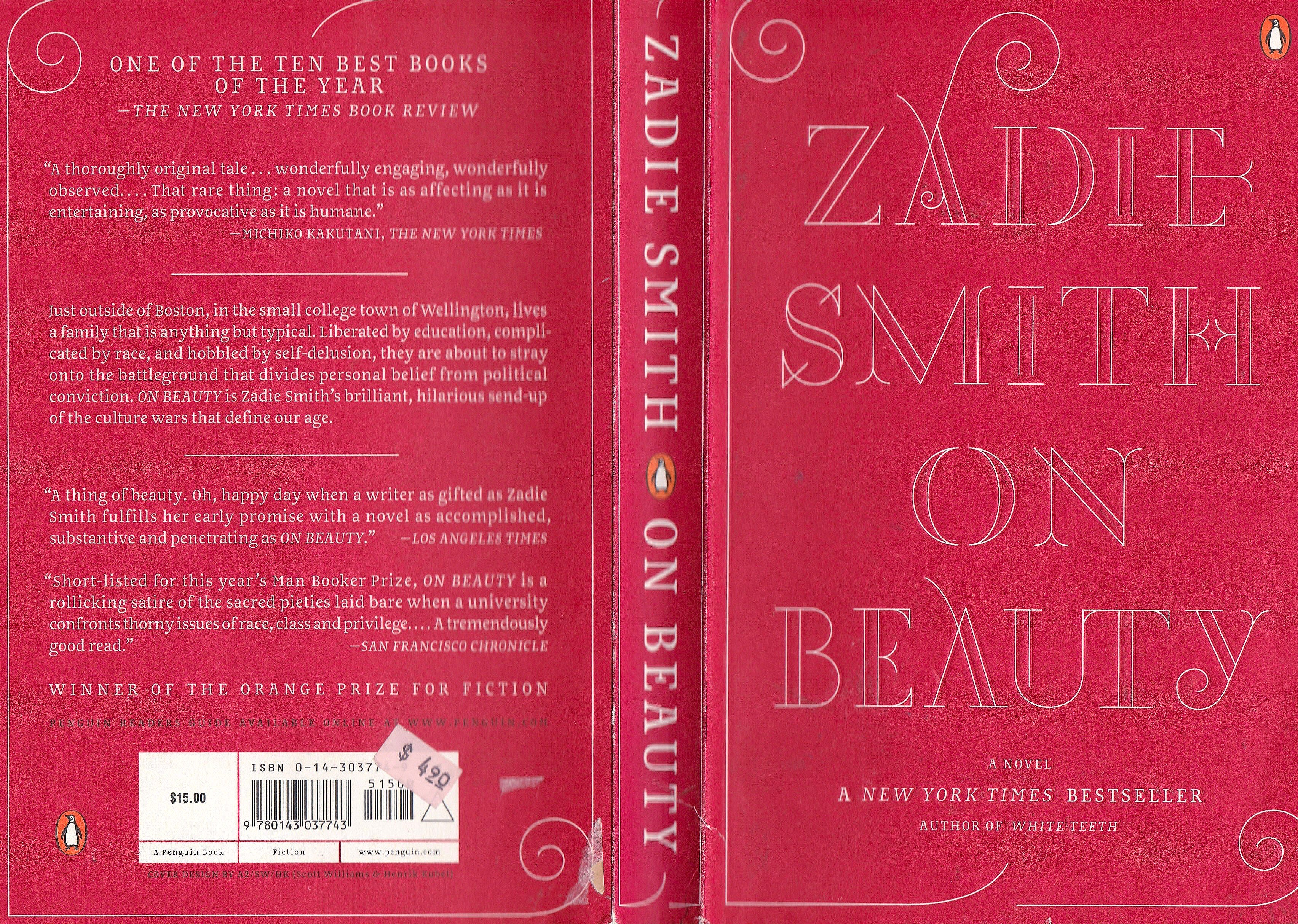
When I get home, I crack it open and flip to the first chapter. Right away, I recognise the opening line, not from my first reading but from another novel. Smith’s first sentence:
“One may as well begin with Jerome’s e-mails to his father.”
is riffing on the first line of Howards End by E. M. Forster:
“One may as well begin with Helen’s letters to her sister.”
Thing is, I haven’t actually read Howards End. I bought a copy months ago, with a view to reading it soon. While I’ve been busy not reading Howards End, I’ve built up my anticipation by keeping it in sight, on a coffee table, and re-reading the blurb, scanning the pages, occasionally reading the first page over and over. That’s how I recognise the reference here. I don’t know what Smith is up to, but I feel a thrill-adjacent tingle when I spot it.
Because I’m a word-nerd, I flip backwards from chapter one of On Beauty to the brief acknowledgments page. Here, Smith mentions her novel’s relation to Howards End:
“It should be obvious from the first line that this is a novel inspired by a love of E. M. Forster, to whom all my fiction is indebted, one way or the other. This time I wanted to repay the debt with homage.”
This is what I recognise in her opening line: the writer as a fellow reader. Here’s someone else who breathes books, who feels we owe something to the novels that move us deeply, who wants to thank their authors. And this is one way to do that, with an homage that nudges other readers in the ribs and offers a knowing wink. It’s the shared experience of an in-joke. It’s a you-had-to-be-there reference that I was there for.
Well, I was sort of there for it, because I get that she’s referencing Forster’s novel, but I don’t know much about it. I just recognise the first line and get a kind of buzz. But what’s the buzz about? Maybe it’s just the minor dopamine hit of gamified life — I’ve achieved something ineffable simply by recognising this rendition of a classic line. Is this the literary equivalent of one of those nerd-service Easter eggs stuffed into every Marvel movie?
Honestly, I’m a little sniffy about that kind of thing. It’s cool, sort of, to spot the name of the director’s best friend hidden in hieroglyphics in the background of an action scene late in the movie. It’s just not that interesting. And let’s not confuse it with the kind of deep criticism that gets you wrestling with a theme and confronting your own prejudice, your mortality, your purpose in being. It seems sad to swap out real criticism for an Easter egg hunt.
But — dessert doesn’t have to be dinner. These Easter eggs serve a purpose, if fun is a worthy purpose, and I think it is. That’s why I plugged an Easter egg into my recent profile of Bill Watterson, constructing a sentence out of the titles of Calvin and Hobbes collections. I did it for no reason other than it made me happy to share a silly “inside baseball” moment with some of my readers. Fun is a worthy thing.
3.
Okay, if I spend too much time thinking about the homage in the first line of On Beauty, I’ll never get on with reading the second line or, you know, the rest of the novel. So I move on.
The first thing I notice is that Smith’s writing is stone-cold gorgeous. Her prose keeps leading me to various kinds of recognition. In the pages of On Beauty, I recognise myself, and I recognise people I know intimately, and I recognise my life and the world in which I live.
Take the way she evokes speech. There’s a bunch of dialects spoken here by various characters. Smith avoids the problem of the caretaker in Wuthering Heights, whose dialogue is rendered impenetrably phonetic, with stuff like “T’maister’s down i’ t’ fowld” and “I’ll hae no hend wi’t”. Paragraphs of this are exhausting. Instead, Smith is a minimalist.
There’s a moment where a young character says, “I spose my mum’s always been at home, which makes a lot of difference, I think.” Did you catch it? Smith recognises that “suppose” is often said just like that, as “spose”. No apostrophe, even though technically a contraction would have it, because the apostrophe would just bring back the syllabic beat Smith removed by taking the “up” out of “suppose”. That’s how it’s said: one beat, one syllable, smooth.
Another character notes how her Caribbean friend pronounces “fair” as “fee-yer”. From that single note, the whole music of the man’s speech plays in my reading ear. I’ve heard that accent and recognise Smith’s unpacking of this piece of pronunciation, and my memory supplies the rest. She’s leveraging close observation so you recognise the dialect and supply it yourself, no need for all that ugly, apostrophised stuff.
Later in the book, a character compares the film-epic winters of his adopted New England with the milder season back home in old England. He notes how in the U.K. you never have to shovel out your rubbish bins from under snow and rarely “see a squirrel tremble”:
“This is because it is never really very cold in England. It is drizzly, and the wind will blow; hail happens, and there is a breed of Tuesday in January in which time creeps and no light comes and the air is full of water and nobody really loves anybody, but still a decent jumper and a waxen jacket lined with wool is sufficient for every weather England’s got to give.”
I know those Tuesdays! I’ve survived so many of them, and I spend so much of the year dreading next January and that miserable breed of Tuesday.
This stuff hits twice, a double whammy. First, you recognise something you know deep in your marrow. Then, the precision of the observation makes that familiar thing surprising. Language becomes a magnifying glass that shows you the microscopic wrinkles in reality’s texture. Something you know well is given back to you in language that isn’t your own, words you wouldn’t have been able to summon to express this stuff yourself. Just like that, the mundane is numinous again.
In the final section of On Beauty, there’s more of this abracadabra in a paragraph about a bohemian couple and their home in London. The house is stuffed with the “chaos of cats” and “jars of unidentifiable food” and “twelve thousand books”, and it all gets wrapped up with a new twist on an old cliché that makes the pedestrian surprising again:
“… too many knicks and a dangerous density of knacks.”
It’s a little thing, but it’s a thing of beauty.
4.
Sometimes, when I’m stuck for something to write, I’ll read a book in the hope of getting a few thousand words out of the 80,000 or so that make a novel. This almost never works. It gelatinises the ink in my pen, the writing is dense, and I realise that I’m forcing things. So I give up, go outside, find something beautiful that I really care about and, hey presto, I’m rushing back to my desk with an idea I wasn’t looking for.
It didn’t cross my mind to write about On Beauty, but one night, I put the book aside and scribbled something about Smith’s paragraph on English weather. I wanted to write about it for the same reason we have book clubs, to share it with someone. After an hour in the lamplight at my desk, I had a couple pages about re-reading On Beauty. I put it in the present tense because the journey was ongoing, and I wanted to bring you, Fellow Reader, along with me.
I thought I’d puzzle out why I’d disliked On Beauty. Maybe I’d reveal something about improving as a reader, or what we want from books, or paying close attention. I kept writing, but I realised that I had no idea why I’d failed to see the greatness in this novel, so any answer would just be posturing. I lost interest in why I hadn’t liked the book before. Instead, I wanted to rave about these tiny treasures I’d unearthed. I looked over what I’d written and thought: So I’m writing about some stuff that made me happy in a book I’m reading?
And then I thought: Is that enough?
This is what Naomi Kanakia calls the “So What?” factor. “Not infrequently,” she writes, “I’d be deep into reading about someone’s experience, which they portrayed with a great deal of care and craft, and then I’d wonder if there was really any larger story here.” This was what my crisis was about: worrying that I had no what in response to that so?
I wanted something that dug down to philosophical bedrock with the spade of a good story. Some grand statement drawn from small details. Extrapolation is what I do, whether it’s wondering what a family novel tells me about the human condition, or working out how a piece of gossip relates to larger cultural norms. When my friends spill the tea, I’m more interested in the nature of teacups and saucers.
More importantly, I care about my readers. I worry about wasting your time, which you’ve been generous enough to share with me and my writing. If you’re going to sit down on a Sunday morning with your coffee and my latest offering pulled from your inbox, it should leave you feeling like it was time well spent.
Time well spent. That’s a concept that’s got me into some trouble recently.
When my wife tells me I’m working too much, that I’m too unforgiving of my human need for rest, that I deserve a little pleasure, so please come watch a movie or play a board game, my tendency is to squirm uncomfortably through this enforced relaxation. Too many evenings have slipped by in a stream of anxiety as I wondered: Will this evening leave me feeling like it was well spent? The only thing I could be sure of counting as “time well spent” was working. Then I burned out.
My road to wellness has been potholed and circuitous; I keep failing to recognise that I’ve slipped off the highway and this attractive little side road is bringing me right back to where I started. I crash, I cry, I spend a few days in bed, then I set off on the journey once again. I keep the car fuelled, mostly, with appreciation for the still small voice that speaks through everyday beauty and small-scale wonder. It’s slow-going, but there’s no other way of getting there.
So, yes, I’ve written about stuff that made me happy in a pretty wonderful book. There’s a ton more that can be said about On Beauty, and maybe I will, another day. For now, I’m getting a kick out of the little things, like recognising one book inside another.
For now, I’m grateful for our readerly fellowship, for the chance to share these small pleasures with you.
For now, joy will have to be enough.